Coil Academy / Materials & Protection
Why HVAC Coils Corrode—and How to Reduce It
Understand what attacks coil metal, what the warning signs can tell you, and how to choose a practical protection plan.
In this article12 sections
Match protection to the cause
HVAC coils corrode when their metals react with the conditions around them. Those conditions may be in the air outside the tubes or in the fluid inside them. Reducing the risk starts with identifying the exposure, then matching the materials, protection, and maintenance to it. No single coating or cleaning routine suits every situation.
Corrosion is different from removable dirt. Washing a dirty coil can uncover sound metal; it cannot replace metal that corrosion has consumed. The aim is to preserve the coil and address the cause of deterioration, rather than simply improve its appearance.
What corrosion does to a coil
Coil fins provide a large surface for heat transfer, while the tubes contain water, refrigerant, or steam. Corrosion can remove fin material or attack a tube wall until a leak develops. The damage may spread across a surface or concentrate at a small location. A coil does not need to look badly deteriorated everywhere to have a serious localized defect.
Rust is one familiar example of corrosion in iron or steel. Coils also contain other metals, so corrosion does not always appear as orange rust. Aluminum normally forms a thin oxide layer that helps protect the metal underneath. An aggressive environment can disrupt that protection. Visible oxidation and loss of useful metal are therefore not interchangeable descriptions.
Start with the air the coil actually receives
Coastal salt, moisture, and certain airborne chemicals can make the environment more aggressive. Distance from the ocean is useful context, but it is not a complete exposure assessment. Look at the air reaching the equipment, the deposits left on it, and nearby sources of contamination.
Indoor coils can face corrosive conditions too. Pool areas, wastewater facilities, and some industrial environments may require special protection. An indoor location does not automatically mean a coil receives clean, noncorrosive air.
For an existing unit, share the location, photographs, maintenance history, and any known chemical exposure with the service team. Describing a site only as “hot and humid” may leave out the condition that matters most.
Three corrosion terms worth understanding
Galvanic corrosion
Galvanic corrosion can occur when different metals are electrically connected and a conductive liquid connects their exposed surfaces. That liquid is called an electrolyte; moisture containing dissolved salts is an example. Under those conditions, one metal can corrode faster than it would on its own.
Think of the arrangement as a small unwanted battery. It needs the right materials and a conductive path to operate. Copper tubes touching aluminum fins do not, by themselves, prove a coil is failing. The environment and the way the materials interact matter.
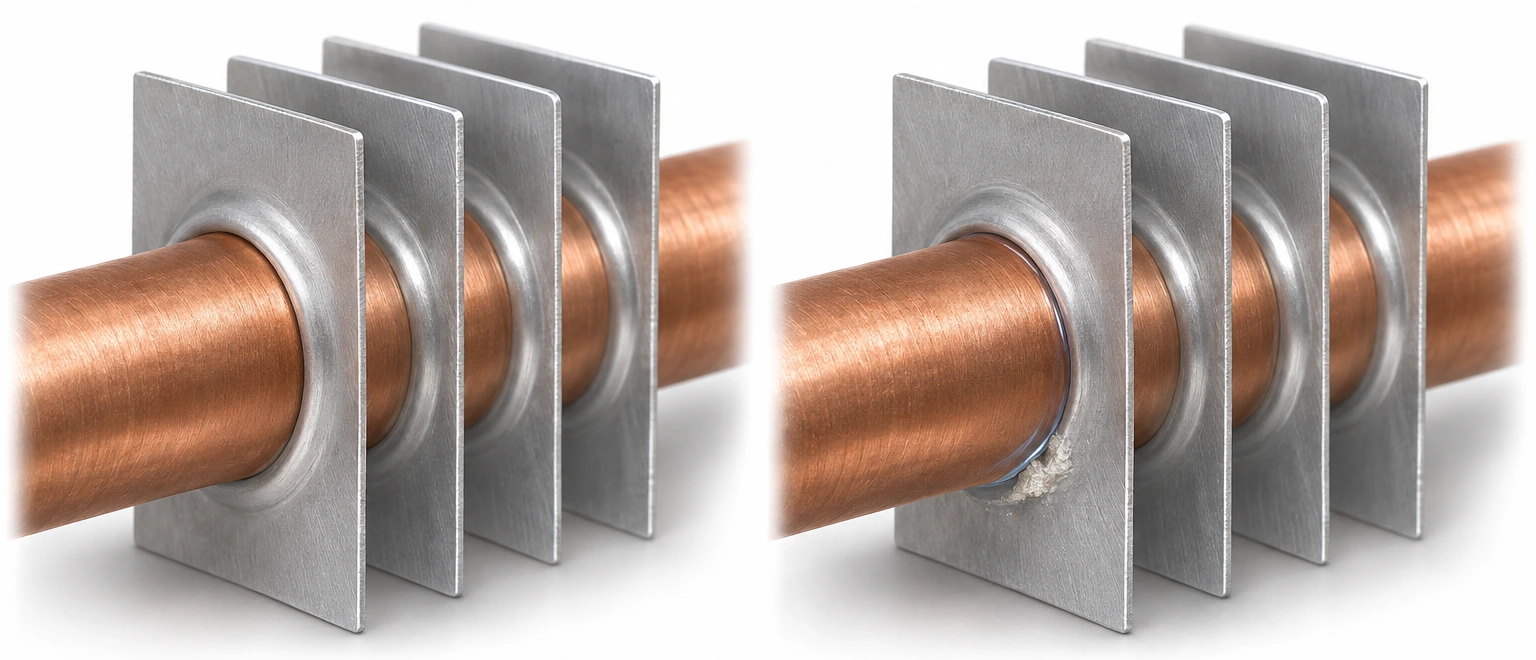
Different metals + electrical contact + conductive moisture. The detail illustrates a possible corrosion cell, not a diagnosis or a guarantee that a wet coil will fail.
Pitting corrosion
Pitting is localized attack that creates small cavities in metal. A pit can penetrate deeply even when most of the nearby surface remains intact. It may also be hidden by corrosion products. This is why a small-looking affected area can deserve closer investigation.
Formicary corrosion
Formicary corrosion is a particular form of attack associated with copper tubing and certain organic-acid conditions. It can create fine, branching tunnels in the metal, resembling an ant’s nest under magnification. The tunnels can eventually reach through the tube wall. This does not mean insects are present, and a photograph of green copper does not establish this diagnosis.
These mechanisms are not a complete list or mutually exclusive labels for every failure. Identifying the actual mechanism may require examination beyond a routine visual inspection.
Color alone cannot tell you the extent of damage
A rusty casing, a discolored copper connection, and a deteriorating aluminum fin pack are different observations. Record where the change appears and whether material is actually missing. Do not judge the whole coil from the color of one part.
Inspection should establish the condition of the fins, tubes, headers, connections, and supports. Suspected leakage needs appropriate testing. Pitting and fine branching attack can be difficult to assess from the visible surface alone, so ask what the inspection confirms and what remains uncertain.
Small mark. Deeper damage.
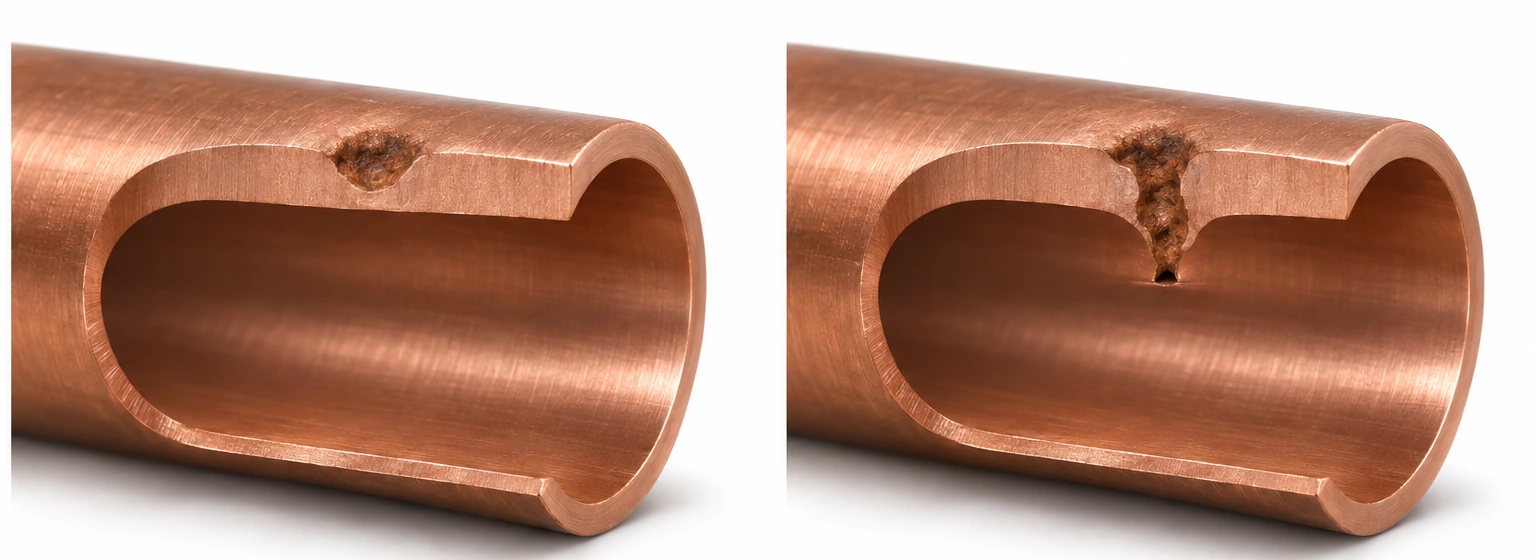
Surface appearance alone does not reveal the depth of attack. The magnified comparison is illustrative and does not identify a corrosion mechanism from appearance alone.
The fluid circuit can cause damage from the inside
In water coils, unsuitable fluid conditions can contribute to internal corrosion and deposits. Those are related maintenance concerns, but deposits are not automatically evidence of corrosion: mineral scale is material accumulating on a surface, while corrosion consumes or changes the underlying metal. A water-treatment specialist should assess the fluid and its compatibility with the system materials.
Steam coils also depend on effective condensate drainage. Under some conditions, inadequate pressure difference prevents condensate from leaving through the trap, even if the trap works. This is called stall. Accumulated condensate can contribute to corrosion and other damage. An external coating does not resolve that operating problem.
Reduce exposure without compromising operation
A protection plan should consider where the contaminants come from. Ask the equipment team whether nearby exhaust, process chemicals, or recurring salt deposits are contributing to the problem. Addressing the source can be as important as protecting the metal.
Changes to equipment location, intake arrangements, or shielding need engineering review. A cover that keeps spray off a coil but restricts required airflow may create another problem. Do not improvise a sealed enclosure around operating equipment.
For fluid systems, include the treatment and monitoring plan. Replacing a corroded coil without addressing unsuitable water conditions can leave the replacement exposed to the same cause.
Choose materials for the actual application
Material selection is a system decision. Tube metal, fin metal, casing, connections, working fluid, and the surrounding atmosphere all need consideration. A material that works well in one environment is not automatically the best option everywhere. Manufacturers offer different combinations for different applications.
Describe the exposure and the previous failure when discussing a replacement. Ask why the proposed combination is suitable, what protection it needs, and what maintenance will be required. If one component is changed, check how it interacts with the rest of the assembly. Choosing a metal by reputation alone leaves those questions unanswered.
What a protective coating can and cannot do
A suitable coating helps separate the metal from a corrosive environment. The coating must suit the coil construction and the actual exposure. Ask which surfaces are protected, how coverage is achieved, and what happens if the coating is damaged.
E-coating is one application method. In a coil-specific process, the assembly is prepared, immersed in a coating bath, coated through an electrical deposition process, and cured. Other systems use different application methods. The method and product specification matter more than the color: a black, blue, or gold appearance does not identify a coating chemistry or process.
Think of the coating as a raincoat. Its protection depends on suitable material, coverage, and condition. A damaged area deserves attention, and the raincoat does not treat a problem inside the wearer. Likewise, an external coil coating does not replace care of the internal water or steam circuit.
The coating is a barrier
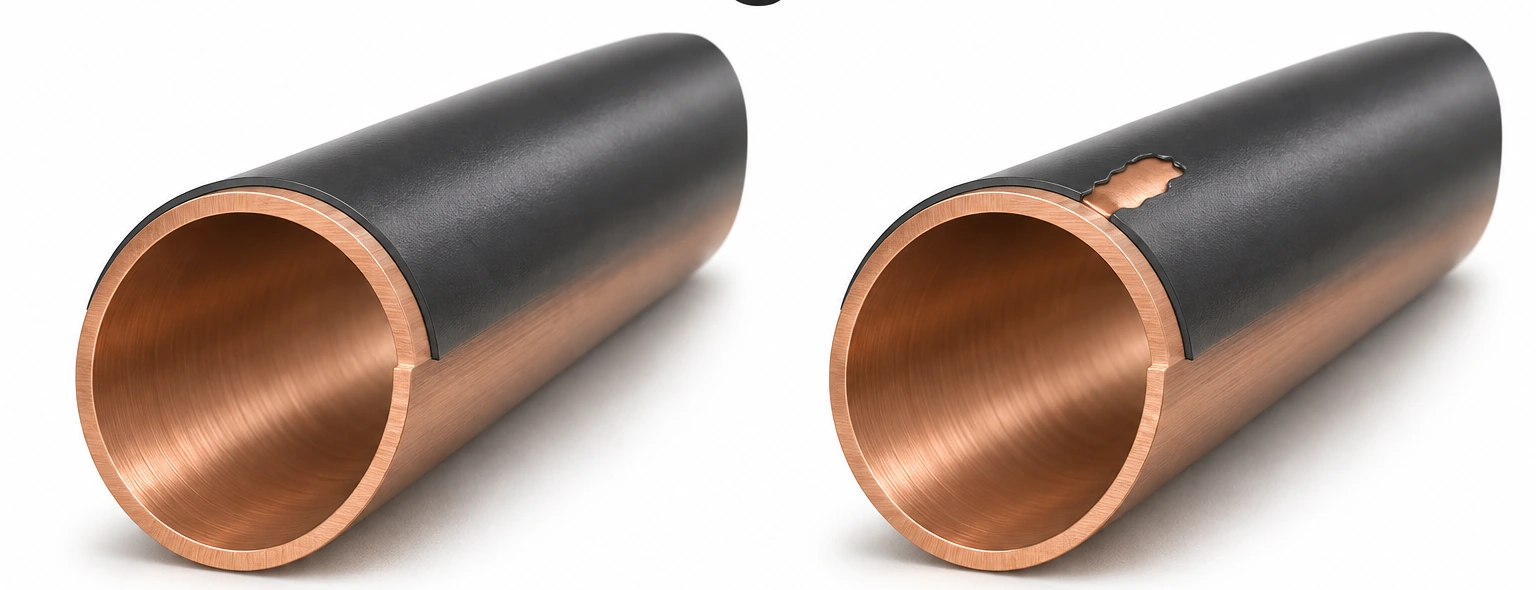
A coating defect can let the environment reach the metal. Illustrative cutaway; coating thickness is exaggerated for clarity. Color does not identify a coating product or process.
Maintain the coating as well as the coil
Coated coils still need cleaning and inspection. Follow the equipment and coating instructions together, including any requirements for removing salts, repairing coating damage, and keeping records. A coil that looks reasonably clean may still be subject to a prescribed maintenance schedule.
Use approved products and application methods. An unsuitable cleaner, excessive force, or brushing across delicate fins can damage the surfaces being protected. Do not assume a cleaner is compatible simply because it is sold for HVAC coils.
Have qualified service personnel carry out work that involves equipment access, electrical isolation, chemicals, or repair. Record the product used, procedure, observed damage, and follow-up work. Cleaning can remove contamination; it cannot restore fins or tube walls already consumed by corrosion.
Read corrosion test claims in context
A coating specification may report hours in a salt-spray test such as ASTM B117. That test creates a controlled laboratory exposure for comparing corrosion behavior under stated conditions. It does not provide a direct conversion from test hours to years beside the ocean.
Ask what was tested, which procedure was used, what counted as failure, and whether the specimen represents the proposed coil and coating. A test result needs that context. It is not, by itself, a guaranteed lifespan for the installed equipment.
Respond to deterioration before assuming replacement
A technician should assess whether the problem is surface contamination, coating damage, a localized defect, or deterioration across the assembly. Correctable issues may justify maintenance or repair. Extensive metal loss or recurring failures may make replacement more reasonable. The condition of the remaining material matters.
If a coil must be replaced, document the suspected cause and the plan to address it. A new coil with the same exposure, unsuitable maintenance, or unresolved fluid problem can encounter the same damage.
Before choosing a protection plan, establish
- Where the attack is occurring and how it was assessed
- Which airborne or internal fluid conditions may be contributing
- Why the proposed materials and coating suit that exposure
- Which surfaces the coating protects and how damage is repaired
- What cleaning, monitoring, and records the plan requires
- Which underlying conditions need correction alongside the coil
Reducing corrosion means matching the solution to the cause. A sound plan combines appropriate materials, suitable protection, and maintenance that preserves both. It also recognizes the limits of an inspection, a coating claim, or a single test result.
Compare service options in Repair or Replace an HVAC Coil?
Coil Recall
Review the article’s main ideas, one card at a time.
Card 1 of 7